a home for your memories
innernet is an ai memory platform that, once connected, stays in the background and saves and carries your context no matter where you go or what app you use.
innernet is available in a growing list of surfaces to connect.
connected, it stops being a transcript and becomes something you can hold.
memory that grows as you live it, and comes with you.
innernet.live/api/mcpvisit /docs for the per-client wiring


meet netti
a growing reflection of your memories and connections. one per person, never the same twice. it grows as you keep things, and takes on the colour of what you keep.
privacy
you are about to put the things you actually think somewhere. here is how it is kept, in plain words, with the mechanism under each one if you want to check.
one thing we won’t pretend: once an ai you connect reads your memory, it’s in that ai’s hands. connect the ones you trust.
develop with innernet
it’s git for thinking.
your context, versioned like code. branch it, roll it back, carry it into any tool. start at docs
the short answers.
innernet is a memory layer for ai tools. it stores the context of your work (decisions, preferences, technical details and the reasoning behind them) in one place, and any ai tool you connect can read and write it. instead of re-explaining your project at the start of every chat, the tool already has it. an agent called netti keeps it organised: it files new information into the right documents, updates them when something changes, and keeps a version history.
run npx innernet in your terminal. it signs you in through your browser, detects the ai tools installed on your machine, connects each one to your memory, and sets up the project you are in. tools it cannot detect (chatgpt, claude.ai, anything on another machine) connect by pasting innernet.live/api/mcp into their settings. setup takes about two minutes, and there is nothing left running afterwards.
claude code, cursor, codex, windsurf, gemini cli, claude desktop, vs code, cline, roo, zed, continue, opencode and antigravity connect automatically. chatgpt and claude.ai connect through their own connector settings. any other tool that supports mcp can connect with the url, and there is a rest api for everything else.
decisions and why you made them, preferences you have stated, constraints, approaches you tried and rejected, who is involved, and where the work currently stands. it is stored as documents and structured entries you can read and edit yourself, not as chat transcripts.
yes. your data is isolated at the database level, so only your account can read it. api keys and tokens are stored hashed, sensitive fields can be encrypted at rest, and nothing is read until you connect a tool. one caveat worth stating plainly: once you connect an ai tool, that tool can read your memory, so connect the ones you trust.
you can export everything, or delete your account and all of its data, at any time from your settings.
no. you use the same tools in the same way. innernet records context as you work and your tools read it when they need it. the one new thing you can do is ask any connected tool what you decided about something, and get an answer from your own memory.
from the blog
what we’re thinking about.
 this week at innernet · 1 october6 new things to open.this week at innernet · 7d
 this week at innernet · 24 septemberone letter.this week at innernet · Sep 24
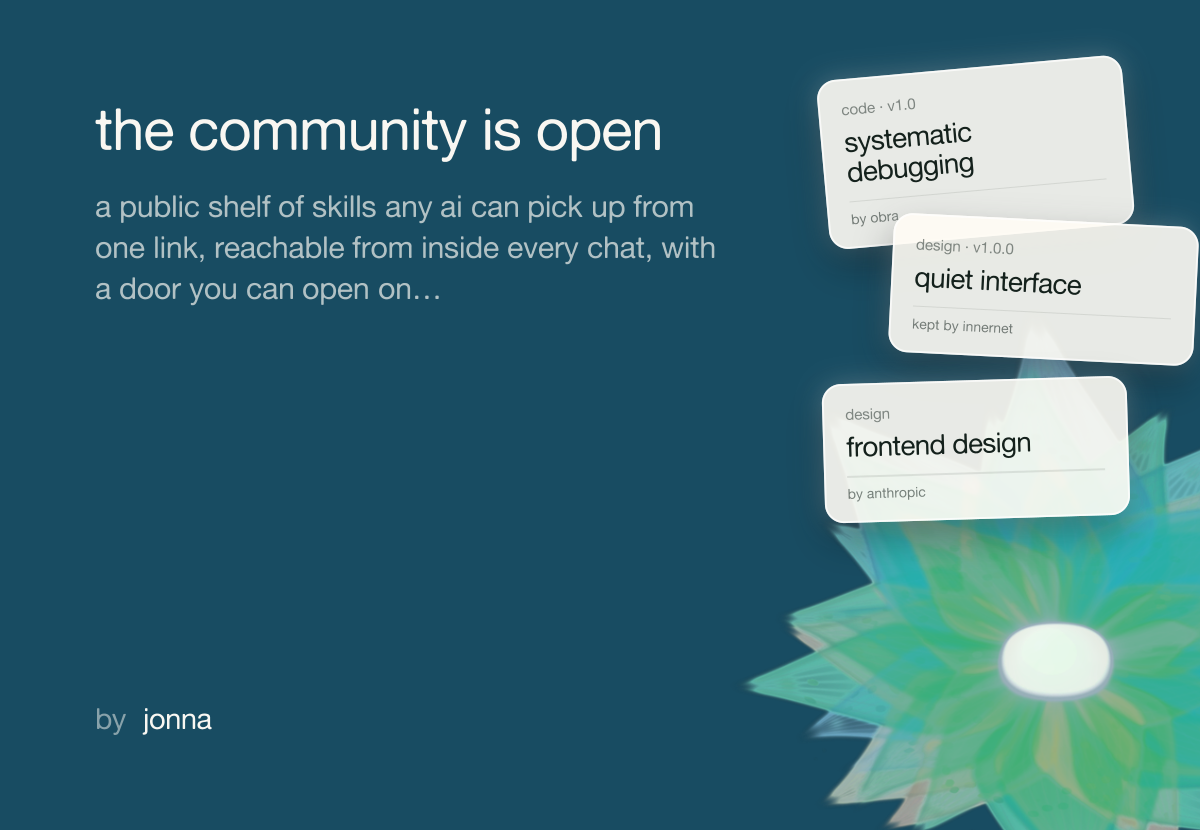 the community is opena public shelf of skills any ai can pick up from one link, reachable from inside every chat, with a door you can open on anything of your own.news · Sep 20
 this week at innernet · 10 septemberone release and one letter.this week at innernet · Sep 10
 rooms of its ownsomewhere to read what innernet is, how it compares, and what changed — each with its own light.release · Sep 8
 ChatGPT memory vs Claude memory: neither can commit what the innernet canand why what’s missing isn’t a smarter assistant, but the layer that lets your thinking move with you.comparisons · Sep 8
 this week at innernet · 3 septemberthe month the door got simpler. one command connects every ai you use, netti meets you the moment you arrive, and the memory underneath learned to keep more of you.this week at innernet · Sep 3
 a face, and a dooryour own netti, born the moment you arrive — and the first way to hand a piece of your memory to someone else.release · Aug 19